Ludic Apparatus
A series of wearable ludic objects, their silhouettes borrowed from the figures that crown Otto Wagner’s Postsparkasse. Where Wagner set his Genien in aluminium above the city, these figures descend to the lapel — Jugendstil rendered in copper, solder mask, and light. The circuit board is not hidden inside the ornament; it is the ornament. Traces curve like tendrils, components sit like set stones.
2026 Soldering Table
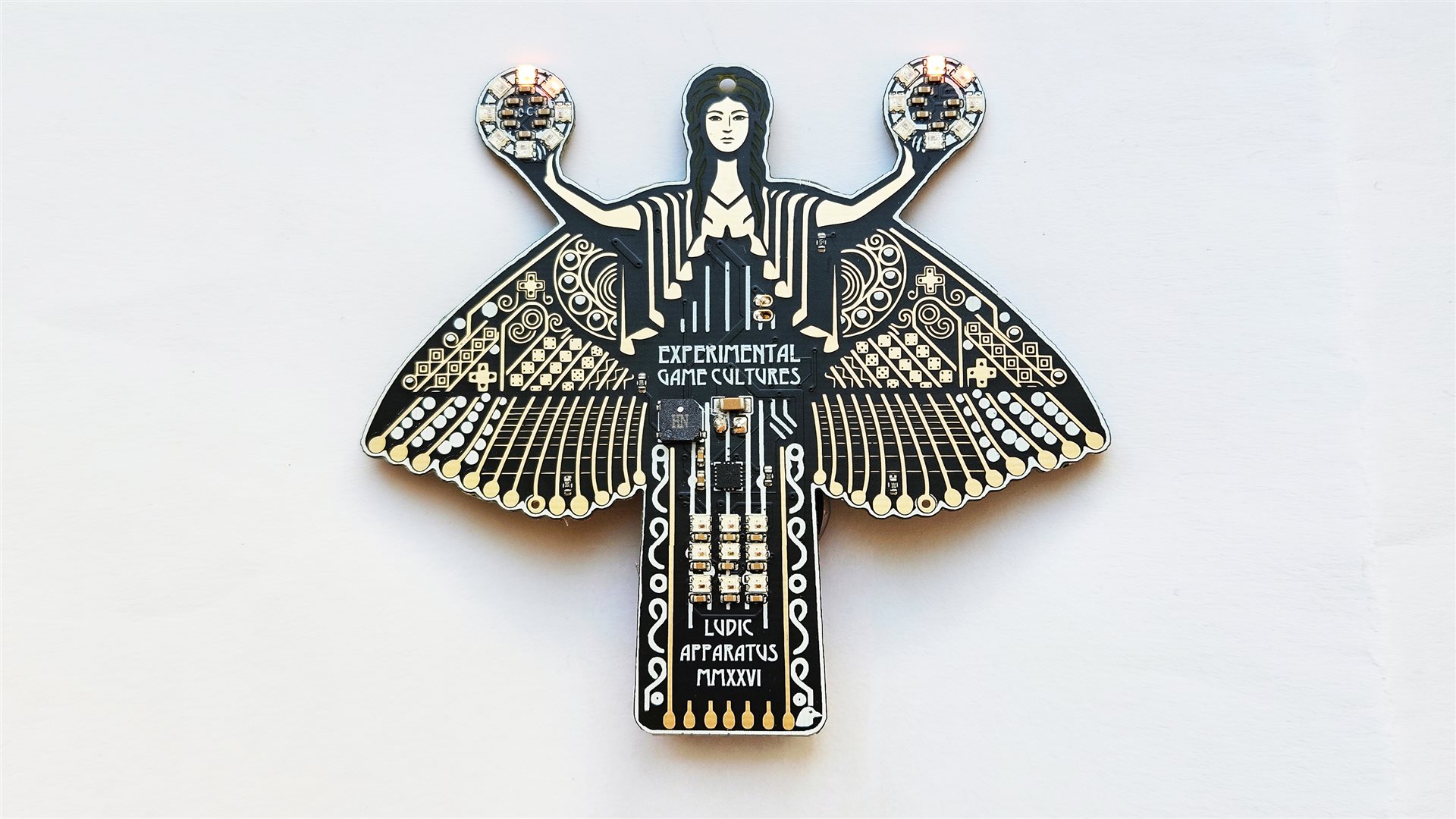
Each brooch is a small autonomous player. Worn on the body and powered by its own battery, it senses the presence of other brooches nearby — a quiet awareness of who else is in the room, in the network, in the game. Tap your brooch and it sends a heartbeat: a pulse of light and sound that ripples outward to every wearer within reach. Nothing is scored, nothing is won. The gesture is the game — a signal given freely to whoever is close enough to receive it.
The brooches turn a gathering into a temporary constellation of co-players. Proximity becomes material; attention becomes touch. In the psycho-ludic sense, they rehearse a small viable future: a network whose only currency is the willingness to say I am here, and I feel you nearby.
Each brooch is a custom-designed printed circuit board built around an ESP32 microcontroller, with addressable LEDs, a gyroscope, and a buzzer assembled from surface-mount components. The brooches speak to one another directly over ESP-NOW, a low-latency radio protocol requiring no infrastructure — the game exists wherever two or more wearers meet. A 500mAh lithium cell and a motion-triggered sleep architecture let the object rest when still and wake when worn, making the game fully portable. Designed, routed, and hand-assembled at the University of Applied Arts Vienna.